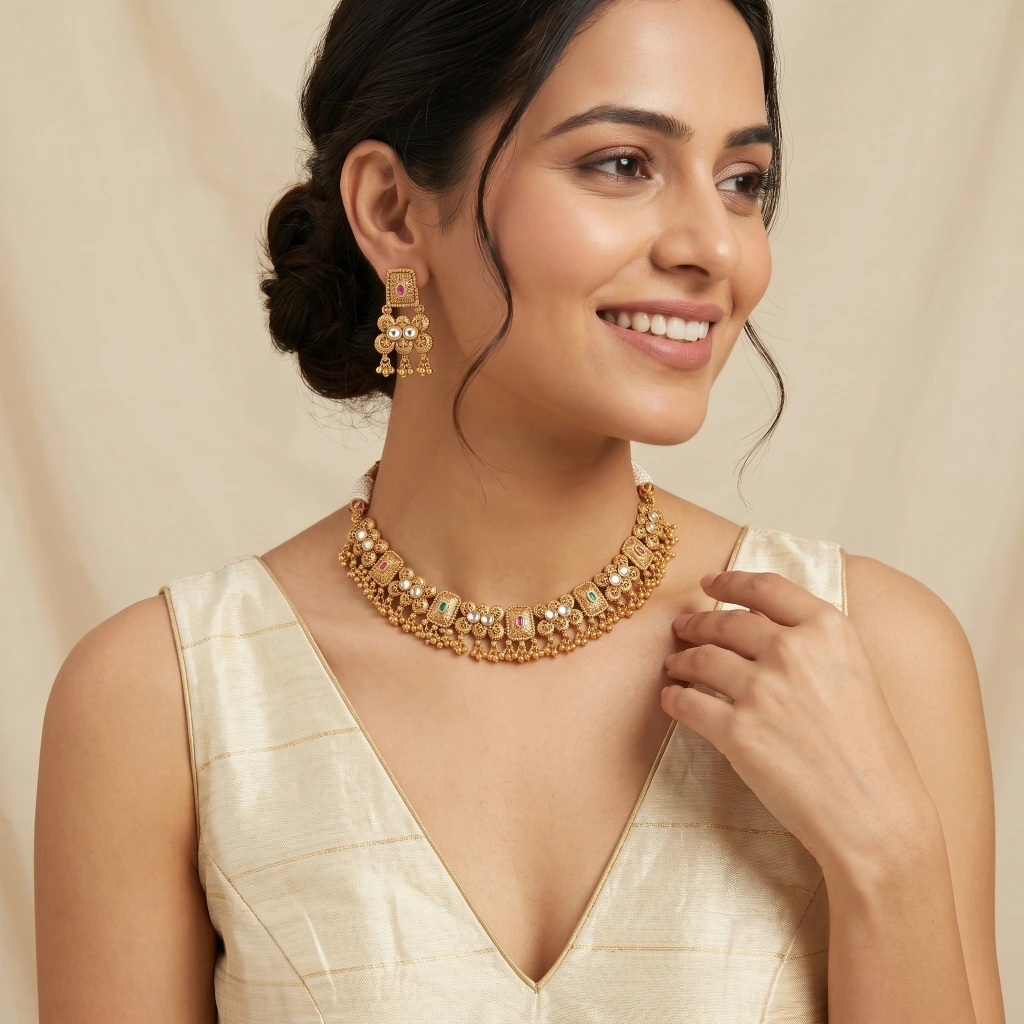
Walk into any wedding shopping conversation in India and someone will eventually say "get a Kundan set" while pointing at something that's technically Temple jewellery, or call a Polki necklace "Kundan" because the two look similar in a bad photo. It's not your fault if you've mixed them up – even seasoned shoppers do. But the three styles come from genuinely different traditions, different techniques, and honestly, different budgets, so knowing which is which will save you from buying the wrong thing for the wrong occasion.
This guide breaks down what actually separates Temple, Kundan, and Polki jewellery – in plain language, no jargon – and points you to real, wearable pieces from the QDORA collection that capture each look without the heirloom price tag.
The Quick Answer
| Style | Signature Look | Best For |
|---|---|---|
| Temple | Antique gold, deity & nature motifs (South India) | Silk sarees, Bharatanatyam, temple visits, South Indian weddings |
| Kundan | Flat-set glass stones in gold foil, layered look (North India) | Lehengas, sangeet, North Indian bridal wear |
| Polki | Rough, uncut stone shine, rustic sparkle (North India) | Wedding day, reception, heirloom-style bridal sets |
Temple Jewellery: Jewellery Born in Devotion
Temple jewellery is exactly what it sounds like – designs that originated as offerings and adornments for temple deities in South India, later adapted for dancers and eventually for everyday brides. The giveaway is always the motif: Lakshmi, peacocks, elephants, lotuses, and coin (kasu) patterns worked into a warm, antique gold finish. There's rarely a sharp, mirror-bright shine here – the whole point is a soft, matte, "been-in-the-family-for-generations" glow.
Temple sets are the natural pairing for a Kanjeevaram or Kasavu saree, and they're the single most common choice for Bharatanatyam and Kuchipudi performances because the motifs and the antique tone read beautifully under stage lighting.
- The Samira Royal Antique Gold Necklace Set – ₹2,999 (25% off) – bold choker silhouette with floral and geometric antique work, ruby-red and forest-green stone accents, and matching statement earrings
- Crimson Royale Antique Gold Jewelry Set – ₹1,199 (20% off) – classic antique gold tone that works equally well with silk sarees and heavier lehengas
- Azure Royale Heritage Jhumkas – ₹799 (20% off) – teardrop-centred jhumkas that lean into the "temple heritage" look on their own, even without a matching necklace
Kundan Jewellery: The Art of the Flat Setting
Kundan is a setting technique before it's a "style" – it refers to how the stones are placed. Traditionally, glass stones (or gemstones) are set into gold foil using a technique that leaves them completely flat against the surface, with no faceting or sparkle in the way a cut diamond would sparkle. The result is a soft, glowing shine rather than a hard glitter, and it's what gives real Kundan jewellery its layered, regal look – necklaces are often built up in tiers, with a choker layer and a longer strand worn together.
Kundan is the North Indian bridal default for a reason: it photographs beautifully, it pairs naturally with a silk dori (thread) closure that adjusts to any neckline, and it goes with everything from a sangeet lehenga to a simple anarkali.
- Celeste Emerald Kundan Necklace Set – ₹2,999 (25% off) – deep emerald-green synthetic stones with clear Kundan-style glass work, a heavy collar necklace paired with statement teardrop earrings, finished with an adjustable silk dori closure – the closest thing to authentic North Indian Kundan styling in the QDORA collection
If you're after the layered Kundan look but on a smaller budget, pair the Celeste set's earrings with a simpler chain for daytime functions and save the full necklace for the main event.
Polki Jewellery: Uncut, Unpolished, Unmistakable
Polki is the one people confuse with Kundan the most, and there's a good reason – both use the same flat-set gold foil technique. The difference is the stone itself. Kundan traditionally uses polished glass or gemstones; Polki uses uncut, unpolished diamonds – raw stones left in their natural rough state rather than faceted for maximum sparkle. That rough, slightly cloudy shine is what gives genuine Polki its old-world, heirloom character, and it's also why authentic Polki sits at the very top of the price ladder in fine jewellery – it's essentially rough diamond set by hand.
In imitation and fashion jewellery, "Polki-style" pieces recreate that rustic, uncut shine using white synthetic stones or Kundan-style glass work cut to mimic the look, so you get the visual drama of Polki – that soft, cloudy-white sparkle against antique gold – without the diamond-level price.
- The Samira Royal Antique Gold Necklace Set – ₹2,999 (25% off) – finished with white Polki-style settings alongside the antique gold and coloured stones, making it a genuine crossover piece for anyone who wants Temple structure with Polki shine
- Azure Royale Blue Stone Necklace Set with Tikka – ₹1,099 (15% off) – a full bridal set with a matching tikka, built for exactly the kind of wedding-day statement Polki is traditionally reserved for
💡 Quick tip: If a piece has a hard, faceted sparkle like a cut diamond, it's not really Polki-style – it's more likely American Diamond (AD) or CZ work. Genuine Polki, real or imitation, has a softer, slightly rough shine rather than a mirror-bright glitter.
How to Tell Them Apart at a Glance
- Look at the motif first. Deities, peacocks, elephants, coins → Temple. No figurative motifs, just stones and gold → Kundan or Polki.
- Look at the stone finish. Smooth, polished, colourful glass → Kundan. Rough, cloudy, mostly white → Polki.
- Look at the gold tone. Warm, matte, slightly dull antique gold → Temple. Bright, high-shine gold foil setting → Kundan or Polki.
- Look at the structure. Single solid choker or long haram → often Temple. Layered strands with a dori closure → often Kundan or Polki.
Which One Should You Actually Buy?
If you're only building one "traditional" jewellery set right now, let the outfit decide:
- Own mostly silk sarees or Kasavu sarees? Go Temple. It's the style built specifically for that fabric and drape.
- Have a lehenga or anarkali for sangeet-style functions? Go Kundan. The layered look was designed for exactly that silhouette.
- Need one showstopper for the actual wedding day or reception? Go Polki-style. It's meant to be the loudest, most photographed piece in your wardrobe.
- Want one set that does double duty? Look for a crossover piece – Temple structure with Polki-style stones, like the Samira set – so you're not buying three separate sets for three separate days.
Shop the Temple, Kundan & Polki Edit at QDORA
Every piece below is anti-tarnish plated and built to hold its shine well past the wedding season – no need to treat it like something you can only wear once.
- Dakshina Ruby Royale Necklace & Earring Set – ₹549 (31% off)
- Azure Royale Heritage Jhumkas – ₹799 (20% off)
- Crimson Royale Antique Gold Jewelry Set – ₹1,199 (20% off)
- Azure Royale Blue Stone Necklace Set with Tikka – ₹1,099 (15% off)
- Celeste Emerald Kundan Necklace Set – ₹2,999 (25% off)
- The Samira Royal Antique Gold Necklace Set – ₹2,999 (25% off)
✔ New arrivals every week ✔ Free shipping above ₹799
Frequently Asked Questions (FAQ)
What is the main difference between Kundan and Polki jewellery?
Both use the same flat gold-foil setting technique, but Kundan traditionally uses polished glass or gemstones while Polki uses uncut, unpolished diamonds (or, in imitation jewellery, white stones cut to mimic that rough, uncut shine).
Is Temple jewellery the same as antique jewellery?
Not exactly – "antique" refers to the matte, aged gold finish, while "Temple" refers specifically to designs featuring deity, peacock, elephant, or coin motifs. Most Temple jewellery is finished in an antique tone, but not everything antique-toned is Temple jewellery.
Which is more expensive – Kundan or Polki?
In fine jewellery, genuine Polki (real uncut diamonds) is significantly more expensive than Kundan, since it uses raw diamond rather than glass or synthetic stones. In imitation jewellery, Kundan-style and Polki-style pieces are usually priced similarly, since both are built with synthetic stones and gold-toned alloy.
Can I wear Temple jewellery with a lehenga?
You can, but it's not the traditional pairing – Temple jewellery is designed around silk sarees and South Indian drapes. For a lehenga, a Kundan or Polki-style set will generally sit and photograph better against the layered, pleated silhouette.
How do I make imitation Temple, Kundan, or Polki jewellery last longer?
Put jewellery on after perfume and makeup, store pieces flat or hanging rather than tangled together, wipe with a soft dry cloth after wear, and avoid water exposure. QDORA's sets come with anti-tarnish plating, which handles the rest.
Where can I buy affordable Temple, Kundan, or Polki-style jewellery online in India?
QDORA carries antique-gold Temple-style sets, Kundan necklace sets, and Polki-style bridal pieces starting at ₹549, with anti-tarnish plating and free shipping across India.