
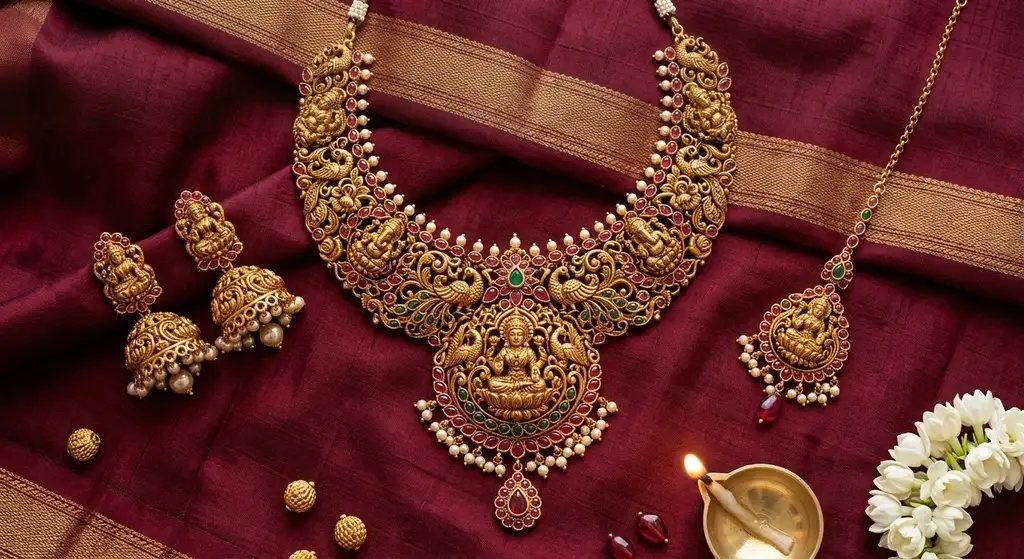
Ask anyone who grew up around South Indian weddings what "temple jewellery" means, and they'll probably picture a specific thing: deep gold, red and green stones, a goddess or a peacock caught mid-motion in the metal. That look didn't start on a jewellery counter — it came from the ornaments goldsmiths once made for temple deities in Tamil Nadu and Andhra Pradesh, which slowly found their way onto brides, dancers, and eventually everyone's festive wardrobe.
The trouble is, once you actually go shopping for it, "temple jewellery" turns out to be an umbrella term covering half a dozen distinct styles, three or four base materials, and a wide range of quality. This guide is meant to sort through that — what the different types actually are, what they're made of, what to check before you pay for something, and how to wear it so it looks intentional rather than costume-y.
What Is Temple Jewellery, Really?
The defining trait isn't the stones — it's the sculptural, almost three-dimensional detailing. Lotus buds, peacocks, mango motifs, deity figures, all raised and worked into the metal rather than sitting flat on top of it. The red-and-green stone combination came later, as a more affordable stand-in for the uncut rubies and emeralds used in the original temple gold.
The Main Types You'll Come Across
Kemp Jewellery
This is what most people mean when they say "temple jewellery" today. It's named after the kemp stone — a synthetic red (sometimes green) stone that mimics uncut gems — set into gold-toned metal in floral or deity patterns. It's the default for South Indian bridal sets, for Bharatanatyam and Kuchipudi costumes, and for anything festive.
Nakshi Work
Nakshi is about the metal itself rather than the stones. Fine engraving or embossing — birds, flowers, tiny deity figures — worked directly into gold or gold-plated brass, often with little or no stone at all. It reads as older and more handcrafted, which is exactly why pieces like the antique gold Lakshmi temple hair barrette have that heirloom quality straight out of the box.
Lakshmi and Deity Motifs
A piece featuring Goddess Lakshmi — seated, standing, or as a coin — is considered auspicious in a way other motifs aren't, which is why they show up so often at weddings, housewarmings, and Diwali. QDORA's Lakshmi temple chain juda pin is a good example of the coin-and-figure style done in miniature, for hair rather than the neck.
Guttapusalu Sets
Originally from Andhra Pradesh, guttapusalu necklaces cluster small gold beads or pearls into a broad, ladder-like band, usually finished with a temple-motif pendant. It's dense, textural, and reads as unmistakably bridal — closer in spirit to a pearl strand like this one than to a delicate chain.
Palakka Jewellery
Kerala's own version — flat, foil-backed stones (traditionally red) set into leaf or flower-shaped gold frames. This is the jewellery you see at Onam and Vishu, worn against the gold-bordered pallu of a Kasavu saree. We've actually written a whole piece on what jewellery pairs best with a Kasavu saree, if that's specifically what you're shopping for.
Temple Chokers and Long Haars
Layering is basically the signature move of temple jewellery — a short choker close to the neck, paired with a longer haar reaching the chest or waist. Pieces like the Vedika heritage gold choker set or the Yaanishi temple gold long haar show that contrast well on their own, but it's the two worn together that gives a bridal look its fullness.
Maang Tikkas and Jhumkas
A matching set almost always includes a maang tikka with a hanging deity or peacock charm, plus jhumkas with that domed top and beaded fringe that catches light when you move. If you're building toward that look, something like the Azure royale heritage jhumkas or the Nandini ruby gold jhumkas gives you the scale without going full bridal.
Temple Bangles and the Vanki (Armlet)
Broad temple-motif bangles and the upper-arm vanki round out the full bridal or dance-costume look, particularly in Tamil Nadu and Andhra Pradesh weddings. QDORA's bangles collection has a few gold-toned options that layer well under a temple choker.
What It's Actually Made Of
This is the part that determines both the price and how long a piece will actually look good — arguably more important than which "type" you're choosing between.
One-Gram Gold
A thick micron-level gold plating over a brass or copper base. It gives you that deep, rich gold colour real gold has, without the real-gold price, and with reasonable care — keeping it away from perfume, sweat, and water — it holds its colour for years rather than months. This is the standard for most temple jewellery sold today, ours included.
Antique Gold-Plated Brass
A slightly duller, oxidised finish meant to look like old, worked gold rather than showroom-new gold. It's especially common on nakshi pieces, since the engraving reads better against a matte, antique surface than a bright, polished one.
Copper Base with Gold Polish
Lighter than brass, which matters more than you'd think on a long haar or a broad armlet — nobody wants a necklace that starts to feel heavy by hour three of a wedding.
Kemp Stones and Polki-Style Stones
Kemp stones are glass or synthetic, hand-set into the metal. On higher-end pieces you'll sometimes see polki-style stones instead — uncut, foil-backed — which get closer to how traditional temple gold actually looked.
Pearls and Beads
Guttapusalu sets in particular lean on real, cultured, or glass pearl beads alongside the gold-toned metalwork, which is what gives them their texture against the smoother surface of kemp or nakshi pieces.
How to Actually Judge Quality Before You Buy
A few things worth checking, whether you're buying in a store or scrolling through product photos online:
- Ask specifically about plating. "One-gram gold" or "micron gold" is a real spec. "Gold finish" on its own could mean almost anything, including a plating that won't survive a single monsoon.
- Look at how the stones sit. They should be flush, with no visible glue overflow, and shouldn't rattle or shift if you gently shake the piece.
- Weight is a decent proxy for quality. Genuine brass-based pieces have a certain heft. If something in the same style is suspiciously light and suspiciously cheap, that's usually thin alloy that won't hold its finish.
- Check the back, not just the front. A well-made piece is finished and polished on the reverse too. A rough, unfinished back is a fast tell for rushed manufacturing.
- Match the motif to what you're wearing it for. Deity and Lakshmi motifs suit weddings and poojas; peacock and floral motifs sit more comfortably in everyday festive wear.
- Buy the coordinated set where you can. A necklace, earrings, and maang tikka from the same collection will simply sit together better than three pieces bought separately and hoped into matching.
How to Style It
With Silk and Kanjeevaram Sarees
This is the classic pairing, and it's classic for a reason. A heavy silk saree in maroon, deep green, or mustard gives a temple choker-and-haar combination somewhere to actually stand out. Resist the urge to add more — one strong necklace set, jhumkas, and a couple of bangles is the whole outfit.
With a Kasavu Saree
For Onam or Vishu, palakka jewellery or a simple temple-motif necklace does the job without fighting the saree's own gold border for attention. A single necklace and a pair of temple-style earrings is genuinely enough here — the Kasavu's border is already doing a lot of the visual work, so over-layering just competes with it.
With Lehengas and Half-Sarees
For a wedding or reception, this is where the full set earns its place — choker, long haar, jhumkas, maang tikka, the works. Pair it against a lehenga or half-saree in a jewel tone like deep red, emerald, or royal blue, so the gold and the kemp stones actually pop against the fabric instead of blending in.
For Bharatanatyam or Classical Dance
Performance jewellery goes bigger on purpose — oversized jhumkas, a layered necklace, a prominent maang tikka, armlets, all in that classic red-and-green kemp palette. It's built to read from the back row, not up close.
For Everyday or Office Festive Wear
None of this needs to be bridal-scale to work. A small pair of temple-motif studs or a delicate nakshi pendant is plenty for a festival at the office or a family function — it adds the traditional note without turning a Tuesday into a wedding.
Keeping It Looking Good
- Store pieces separately, ideally in a soft pouch, so stones and metal don't scratch against each other.
- Perfume, oil, and hairspray go on before the jewellery, not after.
- Wipe pieces down with a soft, dry cloth after wearing, before you put them away.
- Keep kemp-stone settings away from direct water where you can — the setting is the first thing to give.
Shop Temple-Inspired Jewellery at QDORA
Browse our temple-motif necklace sets and jhumka earrings, or pair a piece with an authentic GI-protected Kasavu saree for a look rooted in genuine South Indian craft.
Shop Temple Haar Sets → View Heritage Jhumkas →
✔ Free shipping above ₹999 ✔ Easy returns
Frequently Asked Questions
Is temple jewellery real gold?
Mostly, no — and that's fine. Most temple jewellery today is a brass or copper base with thick gold plating (usually called one-gram or micron gold), which gets you the same rich look for a fraction of solid gold's price. Solid gold temple jewellery does exist, but it's expensive and usually custom-made rather than something you'd buy off a shelf.
What's the actual difference between kemp jewellery and temple jewellery?
Kemp jewellery is one style within the broader temple jewellery category, defined by its red and green kemp stones. Temple jewellery as a whole also includes stone-free nakshi work, pearl-heavy guttapusalu sets, and Kerala's palakka style — none of which necessarily use kemp stones at all.
How long does gold-plated temple jewellery actually last?
Treated reasonably well — away from water, perfume, and being tossed loose into a bag — one-gram gold pieces can hold their colour for years. Thinner, cheaper alloy plating tends to start fading within months, which is usually the giveaway that corners were cut somewhere.
Can temple jewellery work with non-traditional outfits?
Yes, more easily than people expect. Smaller temple-motif studs or a single delicate pendant can sit comfortably with fusion wear — it's really only the full layered sets that read as strictly traditional.
What occasions is it actually meant for?
Weddings, Onam, Diwali, Akshaya Tritiya, poojas, classical dance performances, and honestly any time you're already reaching for a silk saree.