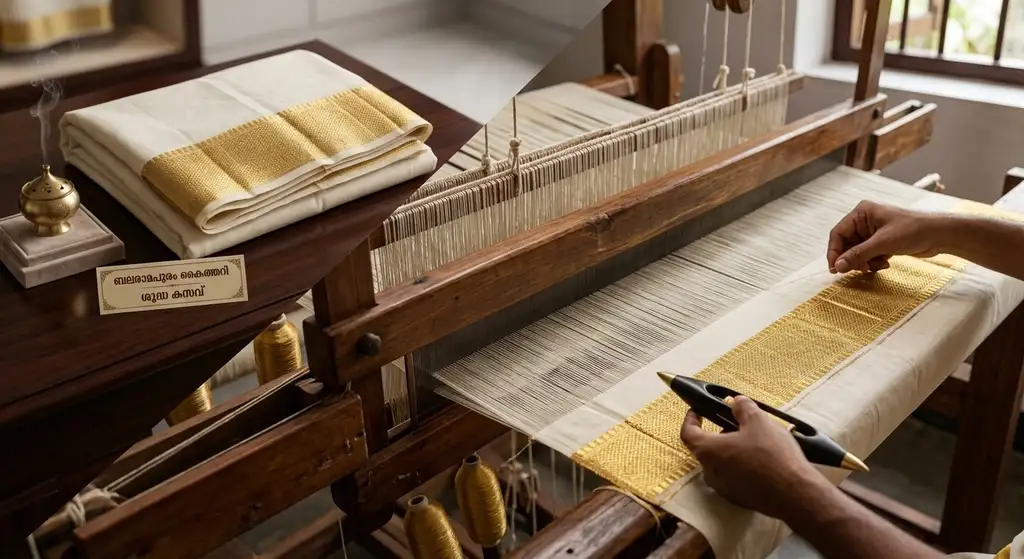
Search "Balaramapuram saree" online and you'll get thousands of results, most of them power-loom fabric with a printed gold border, sold under a name that legally belongs to one weaving cluster in Thiruvananthapuram. It's not always dishonesty – a lot of sellers genuinely don't know the difference either. But if you're paying handloom prices, you deserve the real thing, and telling the two apart is easier than it sounds once you know what to look for.
This guide walks through exactly what separates a genuine Balaramapuram handloom saree from a power-loom imitation – the border, the weave, the zari, the feel – so you can shop with confidence, whether you're buying from QDORA or anywhere else.
Why "Balaramapuram" Is a Protected Name
Balaramapuram isn't just a style – it's a place. The weaving tradition traces back to the 18th century, to the reign of Avittom Thirunal Balarama Varma of Travancore, and the Government of India has granted it a Geographical Indication (GI) tag, along with two other Kerala weaving clusters: Chendamangalam and Kuthampully. That means, legally, only cotton and silk-cotton fabric handwoven in that specific cluster – using the traditional throw-shuttle pit loom, where the weaver sits in a pit and operates the loom by foot – can be called Balaramapuram handloom.
Everything else – printed borders on machine-loomed cotton, or handloom fabric from an entirely different region relabelled with the name – is an imitation, however good it looks in a product photo.
| Check | Genuine Handloom | Power-Loom Imitation |
|---|---|---|
| Back of the fabric | Slight thread irregularities, visible hand-finishing | Perfectly uniform, machine-smooth |
| Border edge (selvedge) | Slightly uneven, small pin marks | Razor-straight, mechanically finished |
| Kasavu (zari) border | Slight weight and texture, muted glow | Flat, printed, or overly bright shine |
| Certification | GI sticker with serial number, Handloom Mark tag | No tag, or a generic "handloom" label |
| Price | Reflects days of manual weaving labour | Unusually low for the claimed craftsmanship |
1. Check the Border First
The kasavu border is the single most recognisable feature of a Balaramapuram saree – a golden zari design running along the edge of an off-white or cream cotton base. On a genuine piece, the zari has a slight weight and texture to it, and the gold tone is warm rather than blindingly bright. Run your fingers along it – real zari sits very slightly raised off the fabric because it's woven in, not printed on.
A printed or heat-pressed border, by contrast, is completely flat, and the "shine" tends to look artificially uniform under different lighting. If the border pattern looks identical, pixel for pixel, across dozens of sarees from the same seller, it was very likely printed rather than woven by hand.
2. Turn It Over and Look at the Back
This is the single biggest tell in any handloom-versus-power-loom comparison, and it works for almost any handwoven textile, not just Kasavu. A handloom saree is woven a few centimetres at a time by a person, over hours or days, and that shows up as small, natural irregularities in the weave – a thread that's a fraction tighter here, a slightly uneven tension there. It's not a flaw; it's proof of the hand behind it.
A power-loom saree, woven by machine in minutes, is mechanically uniform on both sides. If the back of the fabric looks exactly as flawless and machine-smooth as the front, you're very likely looking at a power-loom piece, GI-sounding name or not.
3. Feel the Fabric and the Selvedge
Genuine Balaramapuram handloom uses fine, often hand-spun cotton yarn, and it has a distinct texture – slightly crisp when new, softening beautifully with every wash, and cool rather than clingy against the skin. It should never feel plasticky or overly slick.
Check the selvedge too – the finished edge along the length of the saree. Handwoven selvedges are very slightly irregular, sometimes with small pin marks where the fabric was tensioned on the pit loom. A perfectly straight, almost laser-cut-looking edge usually means a power loom was involved somewhere in the process.
4. Look for the GI Tag and Handloom Mark
The two most reliable, non-subjective checks are official certification:
- GI tag: A tamper-proof holographic sticker with a unique serial number, issued to registered weaver cooperatives producing genuine Balaramapuram, Chendamangalam, or Kuthampully handloom.
- Handloom Mark: A Government of India certification (launched in 2006) showing a stylised hand holding yarn, confirming the product was genuinely handwoven rather than power-loomed. Many certified pieces now carry a QR code you can scan to verify the source directly.
A seller who can't produce either, and can't clearly name the weaving cluster or cooperative behind a specific saree, is a red flag worth taking seriously – regardless of how confidently the listing uses the word "handloom."
💡 Quick tip: Ask the seller directly which cluster the saree was woven in and how long it took to weave. A genuine handloom seller answers immediately and specifically. A vague answer, or one that avoids naming a place or a weaver, usually means the "handloom" claim is more marketing than fact.
5. Be Realistic About Price
A handloom saree, by definition, takes a person real days of manual labour to weave on a pit loom. That labour has a cost, and it shows up in the price. A genuinely handwoven, GI-tagged Balaramapuram saree simply cannot be sold at the same price as a printed, machine-loomed cotton saree with a similar-looking border – if you see "handloom Balaramapuram" priced like fast fashion, be suspicious.
This doesn't mean handloom has to be unaffordable. Entry-level cotton Kasavu pieces exist at accessible price points – but they'll still cost meaningfully more than a power-loom copy of the same design, because the process behind them is fundamentally different.
Quick Checklist Before You Buy
- Border has slight texture and weight, not a flat printed shine
- Back of the fabric shows small natural irregularities, not machine-smooth perfection
- Selvedge (edge) is very slightly uneven, with visible hand-finishing
- Seller can name the specific weaving cluster and cooperative
- GI tag or Handloom Mark is present, or can be shown on request
- Price reflects the labour of hand-weaving, not power-loom manufacturing
Shop Kerala Kasavu Sarees at QDORA
Every Kasavu piece in the QDORA collection is sourced with the weaving cluster, technique, and provenance clearly documented – no vague "handloom-style" labelling.
- Golden Butta Embroidered Kasavu Saree – Handloom Balaramapuram (Kaithari) – ₹1,335 (17% off)
- QDORA Kerala Kasavu Saree Green Border – ₹799 (27% off)
- QDORA Royal Offwhite Gold Checkered Saree – ₹1,015 (28% off)
- QDORA Krishna Kasavu Cotton Saree – ₹1,140 (24% off)
- QDORA Golden Kasavu Tissue Saree – ₹1,450 (9% off)
✔ New arrivals every week ✔ Free shipping above ₹799
Frequently Asked Questions (FAQ)
What makes a saree officially "Balaramapuram handloom"?
It must be cotton or silk-cotton fabric handwoven on a traditional throw-shuttle pit loom within the Balaramapuram weaving cluster in Thiruvananthapuram, which holds a Government of India Geographical Indication (GI) tag protecting the name.
What's the easiest way to tell handloom from power loom at a glance?
Turn the fabric over. Genuine handloom shows small, natural irregularities in the weave on the back, while power-loom fabric is mechanically uniform and equally smooth on both sides.
Does every Balaramapuram saree have a GI tag?
Not always, since certification depends on the individual weaver or cooperative registering for it, but a reputable seller should be able to name the specific weaving cluster and cooperative even without a physical tag on that piece.
Why is genuine handloom more expensive than similar-looking power-loom sarees?
A handloom saree takes a person real days of manual labour on a pit loom to complete, compared to minutes on a power loom. That labour cost is reflected directly in the price.
Can Kasavu sarees be handwoven outside Balaramapuram?
Yes – Chendamangalam and Kuthampully are two other GI-protected Kerala weaving clusters known for Kasavu sarees, each with its own distinct border style, but only fabric woven in the Balaramapuram cluster itself can be labelled Balaramapuram handloom specifically.
Where can I buy genuine Kerala Kasavu sarees online?
QDORA carries Kerala Kasavu sarees with clearly documented weaving provenance, starting at ₹799, with free shipping across India.